
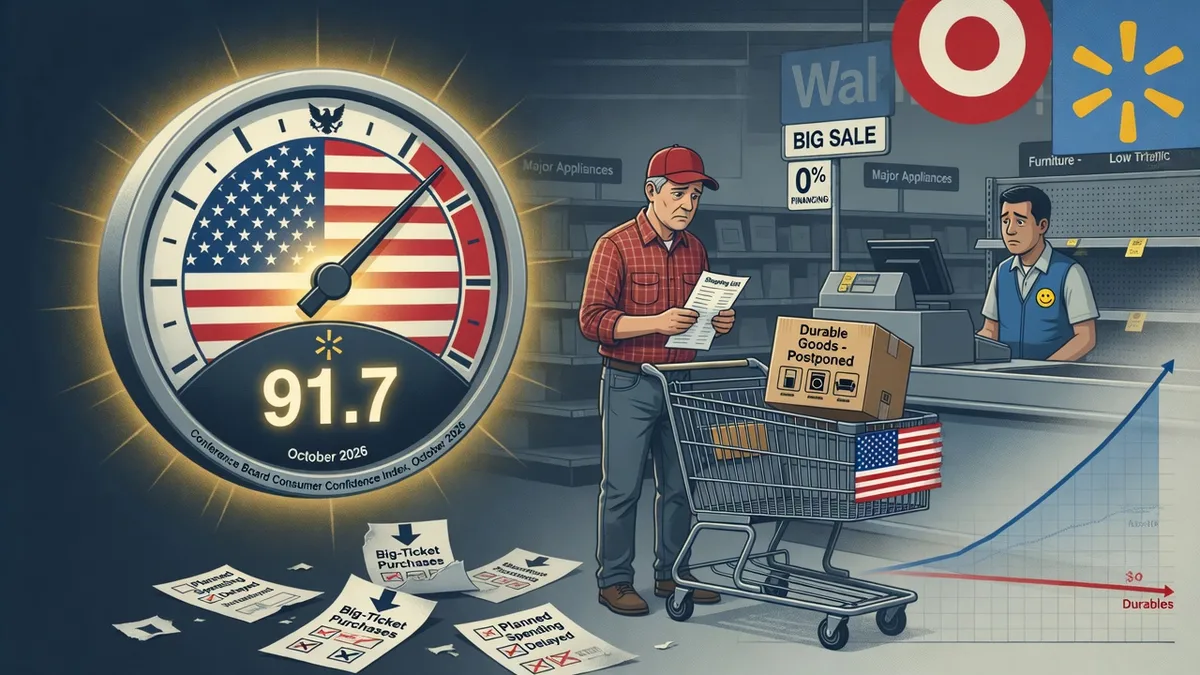
Article analyzes the rise in the US Consumer Confidence Index to 91.7 points in October 2026 and explains why improved sentiment does not guarantee increased retailer profits due to reduced plans for durable goods purchases.
Index Rose, Basket Did Not Get Heavier
On October 27, 2026 The Conference Board reported that the US Consumer Confidence Index rose from the revised 84.2 points in September to 91.7 in October. The 7.5-point increase was noticeable and at first glance should support expectations regarding American demand. However, a more complex picture emerges inside the publication. Households rate the current situation better and look less pessimistic ahead, but at the same time plan to spend less on durable goods and a number of services. This difference matters for the financial market: improved sentiment is not the same as a purchase already made. The index reflects respondents’ answers, while corporate profits depend on actual sales, prices, costs and the structure of demand. An analyst who automatically turns confidence growth into a higher revenue forecast risks missing a deterioration in consumer discipline.
What Exactly the Conference Board Measures
The Consumer Confidence Index is built on a consumer survey and includes assessments of current business and labor conditions, as well as expectations regarding income, business and employment. In October the present-situation index rose 8.6 points to 120.4, while the expectations index added 6.9 points to 72.6. These values sit at different levels. Consumers rate the present far better than the next six months. Consequently, the rise in the overall index partly means a reduction in the intensity of anxiety rather than a shift to sustained optimism. The survey covered the period from October 1 to 21, so it cannot be interpreted as a reaction to events after that date. In addition, the published figures are the result of a statistical study, not a direct measurement of cash receipts or bank transactions.
Why 72.6 Matters More Than the Nice 91.7
The expectations index remains below the conventional 80 level that The Conference Board traditionally views as a signal of heightened risk of economic weakness ahead. This is not a mechanical recession forecast and not a probability of its onset. Methodologically it is correct to say that expectations remain restrained despite the month-on-month improvement. For companies planning hiring, inventories and capital expenditures, this part of the survey may be more useful than the headline number. A buyer can acknowledge that the current situation has improved and at the same time refuse a large purchase because of income uncertainty. The financial market sometimes reacts to the first signal faster than to the second. At such a moment the risk of excessive optimism in consumer-sector profit forecasts increases.
Gasoline Reduced Anxiety but Did Not Cancel Expensive Living
Conference Board economists linked the improvement in sentiment in particular to the easing of retail gasoline prices between September and October. For households this is a tangible factor: transportation costs are paid regularly, so price changes are noticeable in the family budget. However, participants’ comments continued to point to the high cost of food, everyday goods and energy. The difference between a slowdown in the pace of inflation and a decline in the overall price level is important. Even if gasoline becomes cheaper relative to the previous month, the accumulated rise in the cost of products and services remains in the budget. Therefore temporary relief in spending can improve mood without a comparable increase in disposable cash. This mechanism explains why the confidence index can recover before actual discretionary purchases do.
Consumer Expects 5.8% Inflation: Not a CPI Forecast
The average expected price change over the next twelve months, according to the October survey, declined but remained at 5.8%. This is a measure of respondents’ subjective expectations, not official CPI inflation and not an estimate that the statistical agency will necessarily publish such price growth. Households form expectations under the influence of the most visible purchases, including fuel and food. In financial analysis this figure matters because expectations can affect wage negotiations, the propensity to save and the willingness to buy goods on credit. However, 5.8% cannot be transferred directly into a model of Treasury yields or a Fed core-inflation forecast. Monetary policy requires data on actual prices, employment, wages and long-term expectations from different sources.
Labor Market: Positive Difference Does Not Equal Overheating
In October 26.7% of survey participants believed there were plenty of jobs, while 21.4% thought it was hard to find work. The difference amounted to plus 5.3 percentage points, improving 2.4 points over the month. This indicator is useful as an early gauge of labor-market perceptions. But it does not replace payroll, unemployment and vacancy statistics. A respondent may assess the situation from news, the experience of acquaintances or their own position rather than from the economy as a whole. In addition, improved perception of current employment does not mean companies will increase hiring in the next quarter. In the expectations section the share expecting job cuts remained higher than the share expecting increases. Therefore the positive signal from the current labor market should be compared with continuing caution about the future.
Intentions to Buy Cars and Housing Did Not Accelerate
On a six-month moving average, plans to purchase a car and housing declined slightly. This is especially important in an economy with high borrowing costs. A car purchase depends on the monthly payment, not only on the advertised price of the vehicle. With high auto-loan rates a buyer may postpone replacing transportation even if confident of keeping the job. The same logic applies in the housing market: mortgage cost and down payment limit transaction affordability. The drop in intentions does not prove an immediate reduction in sales in every region, but it requires more cautious assessment of demand recovery. For automakers, dealers, mortgage lenders and developers, actual applications, credit approvals and changes in the average payment matter. Confidence without solvency remains a psychological quantity.
Durable Goods: Caution Even After the Bounce
In the October survey intentions to buy durable goods declined across a wide range of categories. In particular, plans to purchase some electronic devices fell by more than one percentage point. For the technology and consumer sectors this is not a universal forecast of revenue decline: corporate sales, equipment replacement and premium categories may move differently. But for the mass market of smartphones, computers, household appliances and furniture such dynamics serve as a signal to check inventory levels. If retailers count on a strong holiday season and ramp up purchases in advance, while consumers turn out less active, discounts may erode margins. Therefore in the coming months’ reports it is necessary to watch inventory turnover, gross margin and advertising spending, not only comparable sales.
Services: Saving Is Selective
The Conference Board recorded a decline in planned spending on many services over the next six months, although cinema, theater, concerts and sporting events looked relatively more resilient. Among popular spending directions remained restaurants, digital subscriptions, utilities, medicine and personal care. The structure of necessity matters here. A household can forgo an extra trip but not electricity, communications or medical care. Therefore overall resilience of service consumption can mask weakness in individual discretionary segments. For an investor in restaurant chains and entertainment companies, visit frequency and average check matter; for telecom and utility operators, customer churn and payment discipline matter more. One aggregated index cannot explain all these differences.
Tourism: 43.3% Plan a Vacation, but These Are Not Bookings
The share of survey participants planning a vacation in the next six months was 43.3%, down from the revised 44.2% in September. At the same time more people oriented toward domestic trips and fewer toward foreign ones. These figures describe intentions, not already paid tickets. They can change under the influence of fares, fuel prices, holiday calendars and exchange rates. For airlines and hotel operators it is important to distinguish between demand volume and its profitability: a reduction in the number of trips is sometimes offset by higher average fares, but not indefinitely. For payment networks and currency-exchange operations, changes in travel geography may matter more than the overall number of vacations. If foreign tourism slows, cross-border payment flows may grow more slowly than domestic consumption even in a stable economy.
Unevenness by Income: Average Index Hides Two Markets
The study notes that on a six-month moving average the rise in confidence occurred mainly among consumers under 35 and households with income of at least $100 thousand. This does not mean all other groups necessarily cut spending in October, but it shows differences in the assessment of economic prospects. High-income families usually have a larger financial buffer and more often benefit from asset-price growth. Households with limited savings feel the prices of food and credit payments more acutely. Therefore the consumer sector can simultaneously demonstrate resilience in premium services and weakness in mass discretionary categories. For company analysis it is necessary to take into account the profile of their client rather than apply the average confidence index uniformly to all buyers.
Fed: What Changed on the Eve of the Decision
The October 27 publication came during the Federal Reserve meeting of October 27–28. At the time this material was prepared the decision following the meeting had not yet been published. Therefore attributing an already adopted rate change to the Fed would be premature. For the regulator, growth in consumer confidence may indicate some resilience in domestic demand, but restrained expectations, inflationary anxiety and plans to reduce discretionary spending form a more complex picture. Monetary policy responds to a broad set of indicators, not to a single confidence value. If the Fed fears persistent inflation, improved sentiment may reduce the arguments for rapid easing. If the labor market weakens, one strong survey will not stop a reassessment of rate prospects. The combination of signals matters.
Treasuries: Sentiment Does Not Equal Yield
US Treasury yields depend on the expected path of short-term rates, inflation premiums, debt supply and investor demand for duration. Improved consumer confidence is sometimes perceived as a sign of more sustainable growth and may support yields, but such a link is not a law. If the index rises because of cheaper gasoline, inflation expectations may decline at the same time. Then part of the effect on the bond market will be the opposite. It is especially dangerous to build a position in ten-year Treasuries solely on a monthly survey. A more reliable analysis includes real yields, breakeven inflation, the yield curve and the market’s reaction to official Fed decisions. For banks, mortgage companies and utilities, the cost of funding matters, not an emotional assessment of the economic situation.
Dollar: Two Sides of Improved Confidence
For the USD, rising confidence can have multidirectional consequences. If it strengthens expectations for the American economy and supports rates, the dollar gains a relative advantage over currencies with softer central-bank policies. But if the improvement is caused by falling fuel costs and is accompanied by lower inflationary pressure, rate expectations may move in the opposite direction. An additional factor is global risk appetite. In periods of confident growth, investors sometimes buy foreign assets more actively, weakening the traditional demand for the defensive dollar. Therefore the link between the Consumer Confidence Index and EUR/USD should not be described with a single arrow. For a currency scenario it is necessary to compare US data with euro-area dynamics, ECB expectations and the actual reaction of interest-rate differentials.
Retailer Stocks: Revenue and Margin Can Diverge
A retail company can increase revenue by raising prices and at the same time lose part of its profit because of logistics, staff and promotional expenses. Improved consumer confidence does not remove this problem. If the buyer becomes more price-sensitive, the retailer is forced to choose between sales volume and gross margin. For chains with strong private labels and a loyal customer base the compromise may be softer. For sellers of electronics, furniture and seasonal goods it is often tougher because of inventories and competition. In the coming reports comparable sales, average check, visit frequency, discount volume and changes in inventory should be compared. Sector reaction to the October survey will be heterogeneous even if the S&P 500 Consumer Discretionary index reacts with a single move.
Credit Cards and Banks: Resilience of Spending Does Not Mean Credit Quality
For credit-card issuers and banks two different processes matter. The first is linked to purchase volume and fee income. The second is linked to repayment of borrowed funds, delinquencies and loss reserves. A consumer can continue using the card but increasingly roll debt over to the next month. In that case payment activity looks resilient while credit quality gradually deteriorates. The October survey does not give a direct answer about the dynamics of charge-offs or delinquency rates. Therefore improved confidence cannot be declared proof of lower banking risk. It is necessary to analyze issuers’ reports, the distribution of debt by income group and actual delinquency data. For payment networks and lenders the same consumer flow has fundamentally different risk economics.
Base Scenario: Cautious Consumption Until Spring 2027
In the base case improved sentiment partly supports spending but does not turn into a broad acceleration of car, housing and appliance purchases. The consumer continues to choose between obligatory payments and discretionary categories, while companies actively manage discounts and inventories. Verification horizon: the next three to six months. Confirmation: moderate real retail sales, absence of a sharp rise in delinquencies and the expectations index remaining at restrained levels. The scenario loses force if plans for large purchases and actual spending begin to accelerate synchronously for several months in a row. Alternative cancellation signal: noticeable deterioration in employment and credit discipline that turns caution into a broader demand slump.
Positive Branch: Confidence Turns into Real Demand
A more favorable scenario assumes stabilization of inflationary expectations, improved credit availability and growth in real household incomes. Then the recovery in confidence will gradually translate into purchases of durable goods, domestic tourism and more resilient service sales. Over the first half of 2027 confirmation will be simultaneous improvement in the expectations index, growth in actual real spending and preservation of retailer margins without aggressive discounts. This scenario should be canceled if consumer intentions continue to decline while headline confidence rises and companies are forced to support revenue with promotions. Even with positive macro dynamics, stocks may not rise if their valuation already assumes stronger demand.
Negative Branch: Sentiment Recovers Before a New Cooling
In the stress configuration the October bounce proves a temporary reaction to cheaper gasoline. Pressure on real incomes, high credit payments and concerns about employment persist, while purchase plans continue to shrink. Then enterprises face slower inventory turnover and the need to cut prices, which reduces margins. Horizon: end of 2026 and first quarter of 2027. Confirmation: decline in real discretionary spending, worsening credit metrics and a new drop in the expectations index. Cancellation criterion: consistent improvement in labor indicators, lower inflationary expectations and sales growth without deteriorating profitability. This scenario should not be declared an inevitable recession: the survey signals risk but does not set the future outcome.
Practical Observation Panel
The following publications should be read as a single system. First group: real retail sales, service spending, auto sales and mortgage applications. Second: employment dynamics, wages and consumer delinquencies. Third: CPI, inflation expectations and actual fuel prices. Fourth: retailer reports on inventories, discounts and gross margin. Fifth: reaction of Treasuries, credit spreads and the currency market to Fed decisions. When analyzing the survey it is necessary to take into account the revision of the September figure from the original 81.9 to 84.2: comparing October with the old base would artificially inflate the size of the improvement. It is also impossible to confuse the expectations index with the probability of recession. Measurement discipline here matters more than a bright interpretation of a single number.
Conclusion: Optimism Can Be Cheaper Than a Purchase
The October rise in consumer confidence to 91.7 points shows that Americans have become less worried about the current situation. But this does not yet mean readiness to buy a car, replace a laptop or book a foreign vacation. The financial market receives not an unambiguous acceleration signal but a more nuanced combination of resilience and caution. For retailers it means the need to protect margins, for banks to control credit quality, for the Fed to assess inflation and employment together, and for the currency and debt markets to avoid mechanical reactions to the survey. The main test will come when sentiment meets cash receipts, bank payments and corporate reports. So far a noticeable distance remains between these quantities.
Sources and Methodology
The Conference Board, US Consumer Confidence, October 27, 2026, corrected release
Reuters, US consumer confidence in October, October 27, 2026
Article prepared by the analytical department of Tradepass