
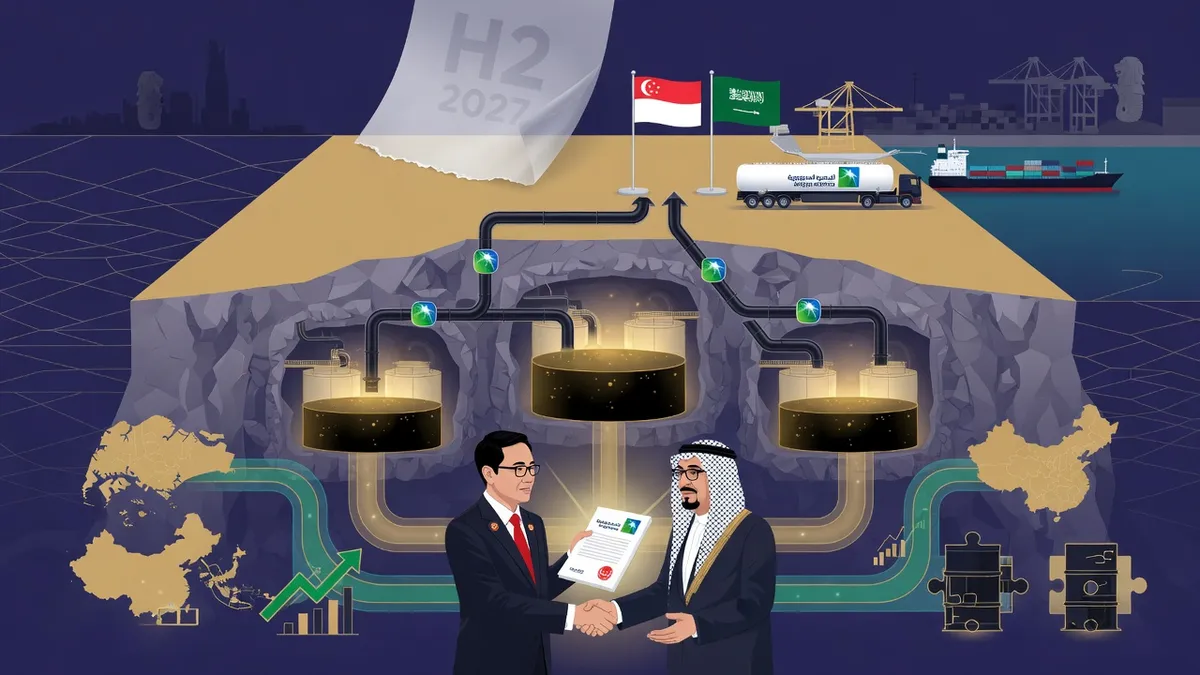
The article analyzes the memorandum between Singapore and Saudi Arabia on placing Saudi oil in the underground storage facilities of Jurong Rock Caverns with operations starting in the second half of 2027 and its significance for regional energy resilience.
Oil simultaneously becomes a product and a factor in the location of access to it.
On October 26, Singapore together with Saudi Arabia announced plans to organize storage of Saudi oil inside the underground complex Jurong Rock Caverns. Singapore's Energy Market Authority and JTC Corporation signed a memorandum with Saudi Aramco at the Singapore International Energy Week conference. The official text from the Singapore ministry indicates that work should begin in the second half of 2027. The document only outlines the direction and does not fix today's supplies or a ready commercial contract, as many details remain to be clarified.
For the commodity market, the announcement carries more significance than it appears at first glance. In the usual scheme, the producer sells oil, a tanker delivers it to the client, and the price depends on the grade, freight, and terms. With regional stocks at the producer's disposal, an additional opportunity arises to keep the resource closer to the consumer and release it during logistics failures or demand surges. The buyer gains a possible buffer against delays on long-haul voyages. The entire system becomes less dependent on the precision of a single route.
The question is not how many barrels exactly can fit in the rock. More important is the question of rights to those barrels, the conditions of their accessibility, and the allocation of maintenance costs for the reserve. It is at this point that energy security becomes an object of financial analysis.
What exactly has been confirmed by the documents of October 26
The main source — the joint statement of Singapore's Ministry of Trade and Industry and Saudi Arabia's Ministry of Energy — confirms the intention to place Saudi oil in Jurong Rock Caverns on Jurong Island. JTC publishes the same text and directly states that the anticipated operations should begin in the second half of 2027. The goal is named as supporting Singapore's energy needs during supply disruptions and increasing the resilience of Saudi Aramco's chain in Southeast Asia.
Reuters provides additional technical data: the underground tanks are located at a depth of about 150 meters and have a total capacity of approximately 1.47 million cubic meters, corresponding to roughly nine million barrels of liquid hydrocarbons. This figure describes the capacity of the complex, not the volume of oil that Saudi Aramco will necessarily place under the new agreement. The latter figure has not been publicly named.
ICIS clarifies that the memorandum is preliminary in nature, and commercial terms will be negotiated in the coming months. Therefore any calculations of specific revenue for Saudi Aramco, rental fees, or mandatory purchase volumes would currently remain speculation. It is possible to analyze economic incentives and potential consequences, but unknown parameters cannot be replaced with invented numbers.
Why Singapore became the natural location for such a reserve
Singapore lies at the crossroads of key Asian sea routes and has long served as an energy, petrochemical, and trading hub. For a company supplying oil to various countries in the region, placing stocks at such a point reduces dependence on the long voyage from the Middle East during sudden local demand. For Singapore, the agreement increases the availability of the physical resource during import disruptions.
However, strategic location alone does not make the reserve economically free. Underground storage requires capital infrastructure, maintenance, oil quality control, insurance, and coordination of access rights. The cost of alternative use of the capacity must also be considered. If demand for storage is high, spare reserve carries an economic price even in a calm period.
This gives rise to an important distinction between nominal and effective energy security. The presence of barrels inside the country does not guarantee the immediate ability to process any grade at any refinery. Characteristics of the feedstock, refinery configuration, pipeline connections, ownership regime, and permitted withdrawal conditions all matter. An effective reserve represents a combination of physical volume, legal right, and technical compatibility.
The lesson of the Strait of Hormuz: a short route can cost more than a long one
According to Reuters, the initiative arose against the backdrop of serious disruptions in energy supplies through the Strait of Hormuz as a result of armed conflict in the Middle East. The agency notes that before the conflict Asia imported about two-thirds of its oil supplies from the Middle East. This is an estimate of regional dependence in the described period, not a universal share for every Asian country.
When a key sea route comes under threat, the price of oil ceases to be determined solely by the balance of production and consumption. Insurance premiums rise, vessel routes change, delivery times lengthen, and working-capital requirements for traders increase. A buyer may face a shortage of a specific grade even when global production is formally sufficient. Regional stocks help reduce this time gap between demand and actual cargo arrival.
At the same time, storage in Singapore does not eliminate geopolitical risk at the supply source. If exports from the region are sustainably reduced, the final stock will be drawn down faster than it can be replenished. The reserve buys time for logistics and contract adjustments but does not create new fields. Its value is therefore greatest in a scenario of temporary disruption and limited in the case of prolonged structural supply shortage.
Nine million barrels: a large figure with an important limitation
The capacity of Jurong Rock Caverns at approximately nine million barrels is impressive in absolute terms, but without comparison to consumption and turnover in the regional market it says little about the degree of protection. The capacity of the complex itself is not equal to available capacity, not equal to the volume of the new agreement, and not equal to a state strategic reserve. Part of the infrastructure may be used under existing commercial contracts, and legal rights to the feedstock may differ.
To assess the real effect, three sets of data would be required. First: how many barrels will actually be reserved, what the filling schedule is, and whether rotation is permitted. Second: who has the right to initiate release of oil, at what price, and under what emergency circumstances. Third: what portion of the volume is technically available in the first days of a crisis, taking into account pumps, pipelines, and terminal throughput.
One cannot calculate the number of days of national autonomy by dividing nine million barrels by an arbitrary figure for Singapore's consumption. Such an operation would create false precision. For a correct calculation, the allocated volume, the structure of petroleum-product consumption, and the existence of other reserves must be known. Until the terms of the agreement are published, professional analysis must retain this limitation.
What Saudi Aramco gains: a new option in the trading portfolio
For Saudi Aramco, regional storage can increase supply flexibility. The company gains the ability to build stocks closer to Asian buyers and respond more quickly to changes in demand. This is especially valuable during periods of elevated maritime logistics risks, when timeliness of delivery becomes a separate element of price. Oil available near the consumer can enjoy a commercial advantage over cargo that still must pass through a potentially congested route.
But the benefit depends on the structure of the deal. If Aramco bears the costs of storage and financing of inventories, capital becomes tied up in the commodity until realization. The cost of such carry depends on interest rates, insurance, lease, and the shape of the oil forward curve. In contango the future price is higher than the near-term price, which sometimes supports the economics of storage. In backwardation the market often rewards immediate delivery, and prolonged holding of the commodity requires additional strategic justification.
The agreement may also strengthen the resilience of customer relationships. A buyer gaining access to stock in the region can perceive the supplier as a more reliable partner. However, this is a qualitative hypothesis, not a measured gain in market share. Its confirmation would require future data on contracts, storage utilization, and commercial terms.
Singapore: energy insurance and industrial policy
For Singapore, the oil reserve has not only commercial but also industrial significance. The country possesses developed refining and petrochemical infrastructure. Disruptions in feedstock supplies can interrupt production of fuels and chemical products, and then transmit to transport, industry, and export chains. Physical stock reduces the likelihood of immediate cessation of operations during a short-term tanker delay.
From a financial perspective, the reserve can be compared to an insurance contract whose premium is paid in advance through infrastructure maintenance and the cost of capital. Its effectiveness is measured not by regular yield but by the amount of potentially prevented damage in a stress scenario. Therefore commercial analysis of the project must take into account storage costs, availability of alternative suppliers, and the probability of logistical failures, not only the market price per barrel.
It is also important to distinguish national security of supply from commercial optimization by Saudi Aramco. These tasks may coincide but are not identical. Specific rights of Singapore to use the oil in a crisis situation must be enshrined in the contract. Until they are disclosed, it cannot be asserted that the entire volume of the complex is automatically at the state's disposal.
A regional model already exists: Japan and South Korea
Reuters recalls that Saudi Aramco has storage agreements in Japan and South Korea. In Japan, storage volume on Okinawa was expanded to 8.2 million barrels in 2017, and in South Korea an agreement was concluded in 2023 to place 5.3 million barrels in Ulsan. In the described models, local authorities received priority rights to purchase stocks in emergency circumstances. These parameters relate to specific contracts and should not be automatically transferred to Singapore.
The economic rationale of a storage network lies in distributing stocks across several demand points. Instead of a single large reserve in the producer country, a geographically diversified system is formed that can reduce local delays. However, it requires coordination of oil grades, commercial rights, stock rotation, and transport capacity. The more complex the network, the more important inventory management and information transparency become.
For investors, this process means increased strategic importance of terminal operators, port infrastructure, oil logistics, and specialized services. But not every company in the sector receives direct benefit. Revenue depends on specific contracts, tariffs, utilization, and the ability to control capital expenditures.
The oil curve: why the reserve can change spreads but not necessarily Brent
Regional storage can influence physical premiums and calendar spreads. If a shortage of a particular grade suddenly arises in Southeast Asia, available stock can reduce the local premium to the international benchmark. But this does not imply an obligatory decline in global Brent. Brent price is determined by the broader balance of production, consumption, inventories, and financial flows, whereas local differentials reflect specific logistics and feedstock quality.
Calendar spreads between near-term and distant futures contracts are especially important. During physical scarcity the near-term contract can trade at a substantial premium. The reserve can smooth this deficit provided the owner is willing and entitled to sell the oil. If the feedstock is legally unavailable or reserved for other purposes, its physical presence does not change market liquidity.
For a trader, the difference between announced storage capacity and actually available barrels is important here. An error in this assessment can lead to an incorrect forecast of the curve, basis spreads, and freight. Analysis must include actual terminal loadings, vessel-flow directions, and contract structure, not only political statements.
Refineries and petrochemicals: who really benefits from stock nearby
For refineries, stability of feedstock supply can be no less important than the average purchase price. An unplanned shutdown due to the absence of a suitable crude grade leads to lost margin, restart costs, and breach of obligations to fuel buyers. Regional stock can reduce the probability of such a shutdown if it is technically compatible with the production process.
However, the refiner evaluates not merely the price of oil but the crack spread — the difference between the value of the product slate and the cost of feedstock after expenses. During a shortage of petroleum products, refinery margin can rise even with expensive oil. When fuel demand falls, margin can compress regardless of the existence of a reserve. Therefore the Saudi Aramco agreement cannot be mechanically counted as positive for the profits of all regional refiners.
Petrochemical companies additionally depend on prices of naphtha, gas, and final polymers. Greater supply security can reduce operational uncertainty but does not cancel cyclical overcapacity or weak demand. For an investor, indicators of utilization, energy costs, product inventories, and debt burden are needed, not only news about physical infrastructure.
Financing inventories: the hidden price of energy resilience
Oil held in storage represents working capital. If the volume has been purchased and not sold, the owner finances its cost, pays for storage, and assumes the risk of changes in market price. At high interest rates, the cost of holding a barrel increases. With an unstable forward curve, the economic attractiveness of physical carry changes. These factors make storage a financial decision, not merely an engineering task.
Trading houses can use commodity financing and futures hedging. But hedging does not eliminate all risks: basis between the specific grade and the benchmark, contract liquidity, margin requirements, and counterparty risk remain. If the cost of collateral rises sharply, even an economically protected position can experience short-term pressure on cash.
In state strategic reserves the criteria are different. Part of the expenditure is justified by preventing losses from an economic shutdown. Even here, however, a transparent assessment of maintenance costs, stock rotation timelines, and usage rules is required. Investors in infrastructure should analyze who bears commodity risk and who receives a fixed storage fee. These are fundamentally different business models with different profit volatility.
Scenarios until the end of 2027: from memorandum to working system
The base scenario assumes completion of commercial negotiations in the coming months and preparation of infrastructure for the start of operations in the second half of 2027, as officially stated. Confirmation will come from publication of mandatory contractual terms, agreement on volume and filling schedule, and then reports of actual commencement of storage. Cancellation criterion: substantial delay in negotiations or abandonment by the parties of the original structure.
The positive scenario includes creation of an effective system of regional access to stocks in which storage volume is combined with clear rights of use during disruptions. This could reduce short-term vulnerability of Singapore's energy sector and increase commercial flexibility for Saudi Aramco. It must be verified by actual operations, speed of feedstock release, and conditions of cooperation, not by rises in exchange quotations.
The negative scenario assumes prolonged disruptions in Middle East supplies or a new increase in logistics costs under which stocks are drawn down faster than they can be replenished. In that case the project retains insurance value but does not solve structural deficit. Revision criterion: sustained restoration of routes, reduction of insurance premiums, and normalization of feedstock availability in the region. All three scenarios are analytical hypotheses, not announced forecasts by governments or companies.
How to monitor implementation and not confuse project with result
First of all, official communications from the Singapore ministry, EMA, JTC, and Saudi Aramco should be tracked. They should answer questions about the legal status of the agreement, allocated capacity, filling schedule, and access rights. The next level of analysis concerns the physical market: directions of oil flows, tanker availability, freight costs, grade differentials, and regional inventories.
The third level includes financial indicators. For Saudi Aramco, cash flow, capital expenditures, working capital, and delivery profitability matter. For infrastructure operators, tariffs, utilization, and long-term contract terms are important. For refineries, refining margin and supply stability must be assessed. For government bodies, the cost of energy insurance relative to prevented damage is important.
Particularly dangerous is substituting expectations for facts. Nine million barrels of total complex capacity are not a proven volume of the new agreement. A memorandum is not the same as a completed contract. The start of operations in the second half of 2027 is a plan, not an already completed delivery. These distinctions may appear formal, but they are precisely what separate a credible valuation from premature capitalization of future advantages.
Conclusion: the market buys not barrels but time
The agreement between Saudi Arabia and Singapore reflects a broader shift in Asia's energy economy. In conditions of unstable sea routes, what matters is not only the cost of production but also the ability to deliver a specific grade of oil to the right place at the right moment. Regional stocks become an infrastructural tool for managing uncertainty.
But this strategy has limits. Storage does not increase global production and does not protect against prolonged cuts in exports. Its value is determined by legal rights, technical accessibility, cost of capital, and quality of management. Until commercial terms are disclosed, investors should evaluate the initiative as a prospective supply architecture, not as already realized profit.
The most important conclusion for the oil market lies in the changing concept of reliability. Previously it was enough to know who could produce a barrel. Now one increasingly has to ask where that barrel is located, how quickly it can be delivered, and who has the right to dispose of it during a crisis.
Sources
Singapore Ministry of Trade and Industry, joint statement, 26.10.2026
Reuters, Saudi Arabia to store crude in Singapore, 26.10.2026
Article prepared by the analytical department of Tradepass