
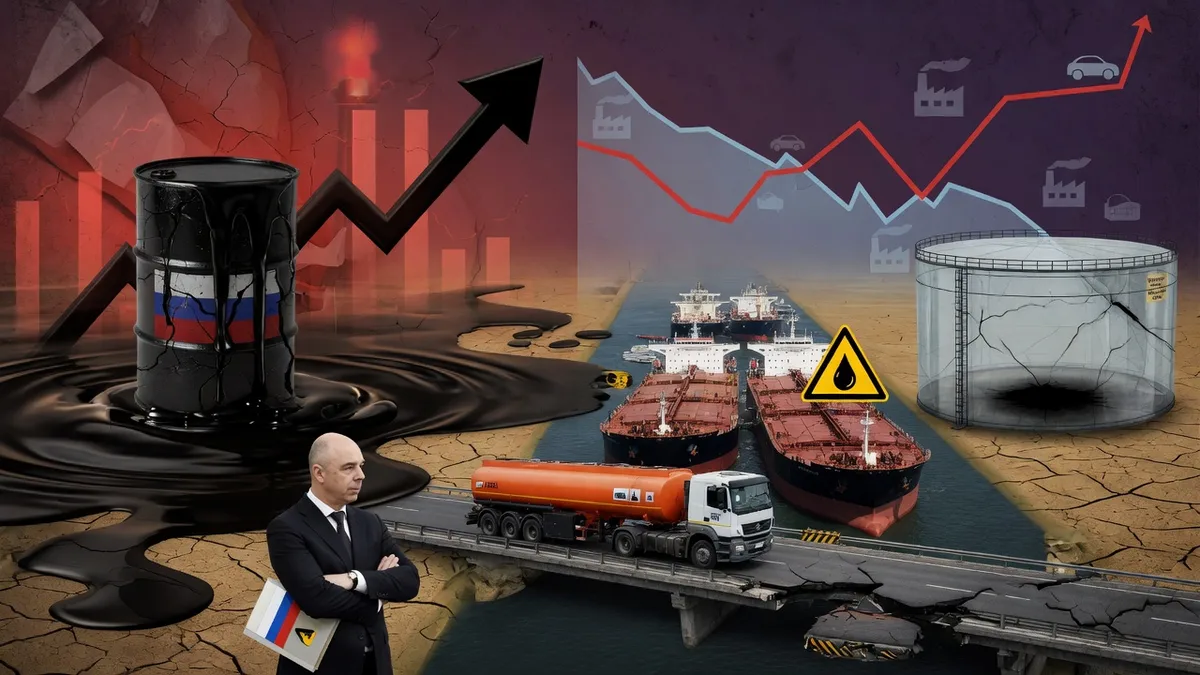
The article analyzes the paradox of the oil market: despite the forecasted decline in global demand, the balance remains in deficit due to diesel shortages, logistical constraints and falling inventories, which supports high physical delivery prices.
Paradox of the new oil market
The International Energy Agency in its October Oil Market Report forecasts a 2.6 million barrel per day decline in global oil demand on average for 2026. This would seem to guarantee a supply surplus and falling prices. However, the agency simultaneously warns of a deficit balance through year-end, an extremely tight diesel market and shrinking inventories. The key to the paradox lies in the difference between crude oil, refined products, logistics and physical availability of deliveries. For oil companies, airlines, freight carriers, inflation and central banks these are fundamentally different risk factors.
Demand falls, yet the market remains in deficit
The October report of the International Energy Agency records a situation that looks contradictory only on a superficial reading of the statistics. The IEA forecasts a 2.6 million barrel per day reduction in global oil demand in 2026 on average versus 2025, to 102.4 million barrels per day. In Q4 demand is expected to fall 2.5 million barrels per day year-on-year. At the same time the agency believes the global market balance will remain in deficit through year-end. The reason is that supply, logistics, refining and inventories are also undergoing a massive shock. A price rise in this situation does not prove accelerating global growth: on the contrary, expensive fuel itself destroys demand. For an investor this means the classic relationship “weak demand – cheap oil” may temporarily cease to work. It is necessary to analyze the physical availability of different grades of crude and products, not only the overall global consumption figure.
Physical market more expensive than the futures market
The IEA notes that at the time of preparing the October report Brent futures were around 107 dollars per barrel, while the physical North Sea Dated indicator reached roughly 134 dollars and certain North Sea grades traded even higher. This is not an error or two mutually exclusive forecasts. A futures contract and a physical delivery of a specific grade have different terms, timing and logistical constraints. The physical premium can rise sharply when a buyer needs an available barrel here and now and delivery is complicated. In September, according to the agency, North Sea Dated rose 26.17 dollars for the month, to 116.89 dollars. These values refer to the dates and instruments indicated by the IEA; they are not current quotes at the time of reading. For valuing oil companies the actual realized price of their blend net of transport costs matters, not only the Brent headline.
Supply recovers, but not enough
World oil production in September rose 2.5 million barrels per day from August and reached 102.3 million barrels per day, the IEA reports. A substantial part of the recovery came from Persian Gulf countries. OPEC+ participants’ output increased and shipments via bypass routes partially recovered. Yet the agency simultaneously forecasts a 5.8 million barrel per day decline in average global supply for 2026, to 100.7 million, followed by recovery in 2027. These figures refer to different time dimensions: the September monthly level cannot be mechanically compared with the annual average without accounting for prior shortfalls. This is where the trap of news interpretations arises. One strong month of recovery does not eliminate the accumulated deficit if logistical risks and infrastructure damage persist. Sustained normalization requires a series of months of stable deliveries, not a single jump in production.
Strait of Hormuz and bypass routes
According to the IEA, in September oil flows through the Strait of Hormuz rose 3.7 million barrels per day to 10.9 million. Bypass export routes also increased volumes and crude exports from Persian Gulf countries approached pre-escalation levels. However, transport infrastructure is not fully interchangeable: pipelines have limited capacity, ports have their own throughput, tankers face availability and insurance constraints. Higher freight rates increase the cost of the delivered barrel even at an unchanged terminal price. New incidents can quickly change insurance premiums and sailing schedules. Therefore supply risk must be assessed not only through geopolitics but also through the physical ability of the system to reroute cargoes. Growth in bypass-route volumes reduces vulnerability but does not eliminate it.
Inventories as a hidden deficit indicator
The IEA reports that at end-September observed global oil inventories were 509 million barrels below the end-February level. In September total inventories fell roughly 10 million barrels, but behind this relatively small figure lies a massive redistribution: onshore stocks declined 113 million while oil on water rose sharply. This means growth in volumes in transit can mask depletion of inventories directly available to refiners. The agency notes that onshore stocks were near multi-year lows at least since 2016. For price, not only how much oil exists in the system matters, but where it is located, when it will arrive and whether its grade suits a particular plant. Therefore weekly inventory data must be read together with tanker flows, refinery utilization and regional differentials.
The diesel market lives by its own rules
The most acute problem in the energy market is not necessarily a shortage of crude oil as such. The IEA indicates that in September global diesel and gasoil exports were roughly 700 thousand barrels per day below the year-earlier level. The combined reduction in shipments from Russia and the Middle East totaled about 1.3 million barrels per day and was only partly offset by other exporters. Diesel is critical for trucking, agriculture, construction, mining and backup power generation. Its demand in the short term is less elastic than demand for some consumer goods. A company cannot instantly stop shipping products even if fuel has become sharply more expensive. Therefore a diesel shortage can affect production costs more strongly than an equivalent percentage rise in crude prices. An investor must track refined-product prices separately rather than treat Brent as a universal indicator of energy inflation.
Refining: high product price does not guarantee high profit
Usually a wide spread between diesel and crude prices supports refinery margins. But in the current cycle this simple logic is disrupted by freight costs, availability of suitable feedstock and constraints on refining capacity. According to the IEA, global refinery throughput is set to reach a seasonal low of about 81.3 million barrels per day in October and recover to 84.6 million by year-end. At the same time record transport expenses and crude prices have eroded margins at some European and Asian plants, while certain U.S. refiners benefit from cheaper feedstock. Consequently an identical rise in diesel quotes can produce different financial results depending on region and refinery configuration. To value companies one must consider crack spreads, delivery costs, light-product yields, plant energy intensity, maintenance and credit availability for inventories.
Why Europe pays twice for fuel
European industry faces both expensive refined products and expensive financing simultaneously. Rising diesel prices increase costs for transport companies and raw-material suppliers, while higher bond yields raise the cost of working capital. A producer can pass part of the costs to the buyer but risks losing order volume; it can hold prices but then margins shrink. As a result the energy shock spreads through the production and logistics chain. Chemistry, metallurgy, agriculture and trucking are especially sensitive. However the degree of risk depends on contracts and the ability to hedge fuel. For equity analysis it is important to check the share of fuel costs, tariff revision timing and currency of purchases. One cannot automatically translate a change in Brent into the profit of a European company: the physical diesel market and transport premiums can behave differently.
Paradox of falling demand: economic destruction does not mean cheap oil
When energy prices rise too quickly, households cut discretionary travel and companies revise production plans. This is exactly what is called demand destruction by high prices. The IEA expects diesel to account for about a quarter of the annual oil-demand decline in 2026. But lower consumption is not proof of excess supply. If refined-product availability deteriorates even faster, the physical deficit persists. The economy therefore receives both an inflationary impulse and lower activity at the same time. For central banks this is a particularly inconvenient configuration: the policy rate can reduce demand but does not restore damaged supply routes or create additional refining. Hence high oil can coexist with slowing GDP and pressure on real incomes. When building scenarios it is essential to model both price and consumption volume, not only one of these dimensions.
Shipping and freight: route price becomes part of the barrel price
In an energy crisis transport ceases to be a secondary expense item. Higher insurance premiums, route changes, shortages of available tankers and unloading delays can create a substantial difference between the price of oil at the producer and the cost of delivery to the refiner. Even with stable production, physical availability of crude worsens if the transport system operates with interruptions. For a trader, time spreads on the futures curve and regional differentials matter; for an industrial buyer, the cost of delivered fuel matters. Companies with their own fleets or long-term shipping contracts may have an advantage, but they too face operational risks. When valuing the transport sector one must separate growth in freight rates from actual profit: higher revenue does not always offset safety, fuel and vessel-idle costs.
China, India and Asia: same barrel, different consequences
Asian refining centers depend on the availability of feedstock of the required quality and on export markets for refined products. If supplies from one region are disrupted, refiners can seek alternative grades, but the technological configuration of a refinery limits substitutability. Reshuffling purchases raises delivery costs and can reduce yields of the most in-demand products. For China both domestic demand and product-export quotas matter; for India import costs and refining margins; for Southeast Asian countries diesel price as a transport and industrial factor. Even with an overall decline in global demand, regional prices can diverge sharply. An investor benefits from watching physical flows, refinery utilization and export restrictions rather than deriving Asian margins from a single global balance.
Who wins and who loses in corporate reporting
In the upstream sector high realized prices can support cash flow, but the outcome depends on available production volume, tax regime, operating costs and hedging. For integrated companies the balance between upstream and downstream matters: upstream profit can rise at the same time as downstream margins deteriorate in certain regions. For airlines rising jet-fuel costs create risk if tickets cannot be quickly repriced without losing demand. Trucking and logistics operators can apply fuel surcharges, but their effectiveness depends on contracts and delays in tariff revision. For chemical plants and packaging producers petrochemical feedstock costs affect margins and working capital. Consequently a blanket bet on the “energy sector” is too crude. One must dissect EBITDA sensitivity, debt load, contract maturities and actual realized prices of each business.
OPEC+ and the limits of price control
Decisions by OPEC+ countries can change targeted production volumes, but the market evaluates more than just quotas. Actual output can deviate from plans because of technical constraints, infrastructure condition and logistics. The October IEA report shows a significant gap between some target levels and observed volumes. This means a formal announcement of a quota increase does not necessarily add the corresponding number of barrels to the market. Available spare capacity that can actually be brought online and maintained, as well as the ability to deliver oil to the consumer, matters. Expectations of future supply recovery also affect price: the futures curve can begin to reflect the 2027 surplus long before it appears. Therefore a forecast cannot be built on a single OPEC+ press release; decisions must be cross-checked against physical statistics, inventories and shipments.
Three scenarios for end-2026 and first half of 2027
Base scenario: global consumption remains under pressure from high prices, but refined-product supply recovers more slowly than crude flows. Diesel spreads remain tight, inventories gradually rebuild and price volatility persists. Confirmation would come from moderate recovery in refinery utilization and no new sharp drop in onshore stocks. Consumer-friendly scenario: transport routes stabilize, physical refined-product deliveries rise, freight premiums decline and diesel prices converge toward crude. Carriers, parts of industry and consumers then win while inflationary pressure eases. Negative scenario: a new logistical delay or weak refining coincides with winter demand, inventories are drawn down and diesel remains significantly more expensive than crude. Its signs are widening crack spreads, stronger backwardation and falling stocks contrary to seasonality. Cancellation of the negative scenario requires several consecutive reports of sustained inventory recovery and product availability. These are conditional scenarios without guaranteed price targets.
Which indicators to check to avoid trading headlines
Weekly monitoring includes commercial oil and product inventories, refinery utilization, diesel exports, freight rates, regional physical-grade premiums and Brent time spreads. Monthly one should compare IEA and OPEC forecasts on demand and supply without mixing their methodologies. Macro statistics are also important: industrial production, transport activity, consumer inflation and real wages show how far high prices have already curtailed economic activity. For companies one must examine quarterly reports on actual realized prices, refining margins and logistics costs. If futures fall while physical premiums remain high, this does not necessarily mean the end of the deficit. If finished diesel inventories rise yet oil prices increase, the mechanism is different. Professional assessment begins with distinguishing these signals.
Conclusion
Global oil demand is declining, yet the refined-product deficit persists. A normalization scenario will be confirmed by sustained growth in inventories and diesel availability; further deterioration of these indicators will cancel it.
Sources
IEA, diesel demand statistics: https://www.iea.org/data-and-statistics/charts/global-gasoil-and-diesel-demand-2024-2027
IEA Oil Market Report, October 2026: https://www.iea.org/reports/oil-market-report-october-2026