
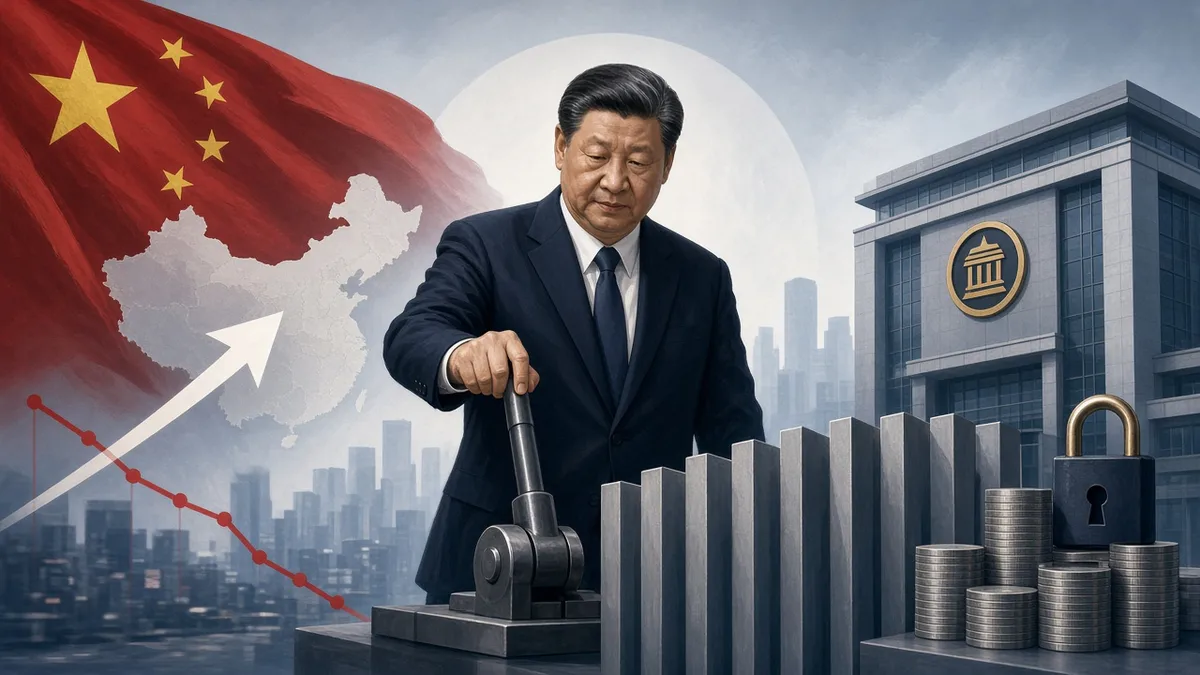
China's central bank from November 15 raises reserve requirements on banks' foreign currency deposits from 4% to 6%, which could tie up about 24 billion dollars in liquidity. The measure is a fine-tuning of currency movement, not a change in economic course.
November 3 The People's Bank of China announced an increase in the reserve requirement for banks' foreign currency deposits from 4% to 6% effective November 15. According to Reuters, the decision could tie up about 24 billion dollars in liquidity. This is fine-tuning the speed of currency movement, not an automatic change in economic course.
What is actually known
November 3 The People's Bank of China announced an increase in the reserve requirement for banks' foreign currency deposits from 4% to 6% effective November 15. According to Reuters, the decision could tie up about 24 billion dollars in liquidity. This is fine-tuning the speed of currency movement, not an automatic change in economic course. Date of analysis: November 3, 2026. All subsequent conclusions marked as scenarios are analytical assumptions, not established facts.
How foreign currency deposit reserves work
For the topic "how foreign currency deposit reserves work" the starting point is the following verified fact: November 3 The People's Bank of China announced an increase in the reserve requirement for banks' foreign currency deposits from 4% to 6% effective November 15. According to Reuters, the decision could tie up about 24 billion dollars in liquidity. This is fine-tuning the speed of currency movement, not an automatic change in economic course. However, the fact should not be automatically turned into an asset price forecast. The key mistake is to take correlation for causation. Movements in yields or stocks may coincide with the news but be caused by a change in global risk appetite. Therefore confirmation requires comparison of several independent series, not a single price chart.
The practical question for the investor is which mechanism will dominate over a one-to-three-month horizon. One should watch USD/CNY, USD/CNH, the dollar index, Asian currencies, Chinese exporters, bank stocks and PRC bonds. At the same time, the mechanical effect of the requirement is not equal to direct intervention; the actual result depends on banks' currency positions and the behavior of exporters. The baseline interpretation assumes gradual transmission of the effect into market expectations, but the speed of reaction will depend on new data and regulator policy. An alternative interpretation allows that the market has already priced in a substantial part of the information and further movement is determined by other factors.
Over a three-to-six-month horizon it is necessary to check whether the initial impulse turns into a sustained cash flow. Confirmation will come from coordinated changes in several indicators: price dynamics, volumes, credit conditions and earnings forecasts. Disconfirmation will be a situation where the headline indicator improves while real orders, margins or credit quality move in the opposite direction. This approach makes it possible to determine the conditions for canceling the scenario in advance rather than explaining the result after the fact.
Why yuan strengthening may be a problem for exporters
For the topic "why yuan strengthening may be a problem for exporters" the starting point is the following verified fact: November 3 The People's Bank of China announced an increase in the reserve requirement for banks' foreign currency deposits from 4% to 6% effective November 15. According to Reuters, the decision could tie up about 24 billion dollars in liquidity. This is fine-tuning the speed of currency movement, not an automatic change in economic course. However, the fact should not be automatically turned into an asset price forecast. Asymmetry matters: a favorable outcome may already be partially reflected in quotes, whereas a negative surprise changes both earnings forecasts and the discount rate simultaneously. Hence the need to assess not only the direction of the event but also the degree of its surprise relative to consensus.
The practical question for the investor is which mechanism will dominate over a one-to-three-month horizon. One should watch USD/CNY, USD/CNH, the dollar index, Asian currencies, Chinese exporters, bank stocks and PRC bonds. At the same time, the mechanical effect of the requirement is not equal to direct intervention; the actual result depends on banks' currency positions and the behavior of exporters. The baseline interpretation assumes gradual transmission of the effect into market expectations, but the speed of reaction will depend on new data and regulator policy. An alternative interpretation allows that the market has already priced in a substantial part of the information and further movement is determined by other factors.
Over a three-to-six-month horizon it is necessary to check whether the initial impulse turns into a sustained cash flow. Confirmation will come from coordinated changes in several indicators: price dynamics, volumes, credit conditions and earnings forecasts. Disconfirmation will be a situation where the headline indicator improves while real orders, margins or credit quality move in the opposite direction. This approach makes it possible to determine the conditions for canceling the scenario in advance rather than explaining the result after the fact.
The difference between managing pace and changing the trend
For the topic "the difference between managing pace and changing the trend" the starting point is the following verified fact: November 3 The People's Bank of China announced an increase in the reserve requirement for banks' foreign currency deposits from 4% to 6% effective November 15. According to Reuters, the decision could tie up about 24 billion dollars in liquidity. This is fine-tuning the speed of currency movement, not an automatic change in economic course. However, the fact should not be automatically turned into an asset price forecast. Separately, companies' balance sheets should be assessed. High revenue does not guarantee high free cash flow if working capital, investments and interest expenses are rising. For the credit market this may be more important than the quarterly sales pace.
The practical question for the investor is which mechanism will dominate over a one-to-three-month horizon. One should watch USD/CNY, USD/CNH, the dollar index, Asian currencies, Chinese exporters, bank stocks and PRC bonds. At the same time, the mechanical effect of the requirement is not equal to direct intervention; the actual result depends on banks' currency positions and the behavior of exporters. The baseline interpretation assumes gradual transmission of the effect into market expectations, but the speed of reaction will depend on new data and regulator policy. An alternative interpretation allows that the market has already priced in a substantial part of the information and further movement is determined by other factors.
Over a three-to-six-month horizon it is necessary to check whether the initial impulse turns into a sustained cash flow. Confirmation will come from coordinated changes in several indicators: price dynamics, volumes, credit conditions and earnings forecasts. Disconfirmation will be a situation where the headline indicator improves while real orders, margins or credit quality move in the opposite direction. This approach makes it possible to determine the conditions for canceling the scenario in advance rather than explaining the result after the fact.
Corporate conversion of export revenue
For the topic "corporate conversion of export revenue" the starting point is the following verified fact: November 3 The People's Bank of China announced an increase in the reserve requirement for banks' foreign currency deposits from 4% to 6% effective November 15. According to Reuters, the decision could tie up about 24 billion dollars in liquidity. This is fine-tuning the speed of currency movement, not an automatic change in economic course. However, the fact should not be automatically turned into an asset price forecast. Sectoral consequences are uneven. Companies able to pass on cost increases to the end buyer are in a different position from businesses with fixed contracts. Currency exposure, debt maturity and procurement structure amplify differences even within the same industry.
The practical question for the investor is which mechanism will dominate over a one-to-three-month horizon. One should watch USD/CNY, USD/CNH, the dollar index, Asian currencies, Chinese exporters, bank stocks and PRC bonds. At the same time, the mechanical effect of the requirement is not equal to direct intervention; the actual result depends on banks' currency positions and the behavior of exporters. The baseline interpretation assumes gradual transmission of the effect into market expectations, but the speed of reaction will depend on new data and regulator policy. An alternative interpretation allows that the market has already priced in a substantial part of the information and further movement is determined by other factors.
Over a three-to-six-month horizon it is necessary to check whether the initial impulse turns into a sustained cash flow. Confirmation will come from coordinated changes in several indicators: price dynamics, volumes, credit conditions and earnings forecasts. Disconfirmation will be a situation where the headline indicator improves while real orders, margins or credit quality move in the opposite direction. This approach makes it possible to determine the conditions for canceling the scenario in advance rather than explaining the result after the fact.
Dollar liquidity inside the Chinese banking system
For the topic "dollar liquidity inside the Chinese banking system" the starting point is the following verified fact: November 3 The People's Bank of China announced an increase in the reserve requirement for banks' foreign currency deposits from 4% to 6% effective November 15. According to Reuters, the decision could tie up about 24 billion dollars in liquidity. This is fine-tuning the speed of currency movement, not an automatic change in economic course. However, the fact should not be automatically turned into an asset price forecast. Here it is essential to distinguish a change in the level of the indicator from its impact on the marginal price of capital. The market discounts not only current statistics but also the trajectory of the following quarters. Therefore the same news can support corporate profits while simultaneously worsening valuation multiples. To test the hypothesis it is necessary to observe actual cash flows, financing costs and the dynamics of expectations.
The practical question for the investor is which mechanism will dominate over a one-to-three-month horizon. One should watch USD/CNY, USD/CNH, the dollar index, Asian currencies, Chinese exporters, bank stocks and PRC bonds. At the same time, the mechanical effect of the requirement is not equal to direct intervention; the actual result depends on banks' currency positions and the behavior of exporters. The baseline interpretation assumes gradual transmission of the effect into market expectations, but the speed of reaction will depend on new data and regulator policy. An alternative interpretation allows that the market has already priced in a substantial part of the information and further movement is determined by other factors.
Over a three-to-six-month horizon it is necessary to check whether the initial impulse turns into a sustained cash flow. Confirmation will come from coordinated changes in several indicators: price dynamics, volumes, credit conditions and earnings forecasts. Disconfirmation will be a situation where the headline indicator improves while real orders, margins or credit quality move in the opposite direction. This approach makes it possible to determine the conditions for canceling the scenario in advance rather than explaining the result after the fact.
Spot, forwards and currency hedging
For the topic "spot, forwards and currency hedging" the starting point is the following verified fact: November 3 The People's Bank of China announced an increase in the reserve requirement for banks' foreign currency deposits from 4% to 6% effective November 15. According to Reuters, the decision could tie up about 24 billion dollars in liquidity. This is fine-tuning the speed of currency movement, not an automatic change in economic course. However, the fact should not be automatically turned into an asset price forecast. The first transmission channel runs through expectations and the price of risk. The second channel is linked to actual contracts, inventories and payments. They operate with different lags: the currency market reacts quickly while operating reporting records consequences later. It is precisely the divergence of these horizons that often creates false confidence in the initial reaction.
The practical question for the investor is which mechanism will dominate over a one-to-three-month horizon. One should watch USD/CNY, USD/CNH, the dollar index, Asian currencies, Chinese exporters, bank stocks and PRC bonds. At the same time, the mechanical effect of the requirement is not equal to direct intervention; the actual result depends on banks' currency positions and the behavior of exporters. The baseline interpretation assumes gradual transmission of the effect into market expectations, but the speed of reaction will depend on new data and regulator policy. An alternative interpretation allows that the market has already priced in a substantial part of the information and further movement is determined by other factors.
Over a three-to-six-month horizon it is necessary to check whether the initial impulse turns into a sustained cash flow. Confirmation will come from coordinated changes in several indicators: price dynamics, volumes, credit conditions and earnings forecasts. Disconfirmation will be a situation where the headline indicator improves while real orders, margins or credit quality move in the opposite direction. This approach makes it possible to determine the conditions for canceling the scenario in advance rather than explaining the result after the fact.
Link to the trade surplus
For the topic "link to the trade surplus" the starting point is the following verified fact: November 3 The People's Bank of China announced an increase in the reserve requirement for banks' foreign currency deposits from 4% to 6% effective November 15. According to Reuters, the decision could tie up about 24 billion dollars in liquidity. This is fine-tuning the speed of currency movement, not an automatic change in economic course. However, the fact should not be automatically turned into an asset price forecast. The key mistake is to take correlation for causation. Movements in yields or stocks may coincide with the news but be caused by a change in global risk appetite. Therefore confirmation requires comparison of several independent series, not a single price chart.
The practical question for the investor is which mechanism will dominate over a one-to-three-month horizon. One should watch USD/CNY, USD/CNH, the dollar index, Asian currencies, Chinese exporters, bank stocks and PRC bonds. At the same time, the mechanical effect of the requirement is not equal to direct intervention; the actual result depends on banks' currency positions and the behavior of exporters. The baseline interpretation assumes gradual transmission of the effect into market expectations, but the speed of reaction will depend on new data and regulator policy. An alternative interpretation allows that the market has already priced in a substantial part of the information and further movement is determined by other factors.
Over a three-to-six-month horizon it is necessary to check whether the initial impulse turns into a sustained cash flow. Confirmation will come from coordinated changes in several indicators: price dynamics, volumes, credit conditions and earnings forecasts. Disconfirmation will be a situation where the headline indicator improves while real orders, margins or credit quality move in the opposite direction. This approach makes it possible to determine the conditions for canceling the scenario in advance rather than explaining the result after the fact.
Scenario map and conclusion
The baseline scenario for one to three months assumes gradual adaptation of financial conditions without a sharp change in global demand. The positive scenario for three to six months requires confirmation of the resilience of real activity and improvement in earnings quality. The negative scenario materializes when price pressure, deterioration in credit conditions and revision of rate expectations combine. None of the scenarios implies a guaranteed movement in quotes.
The main conclusion is not an attempt to guess the next market tick. A more meaningful task is to determine which data will change the balance of probabilities. To do this it is necessary to track real volumes, the inflationary component, the cost of funding and corporate cash flows simultaneously. A signal should be considered confirmed only when independent indicators form a single causal picture.
Sources
Article prepared by the analytical department of TradePass