
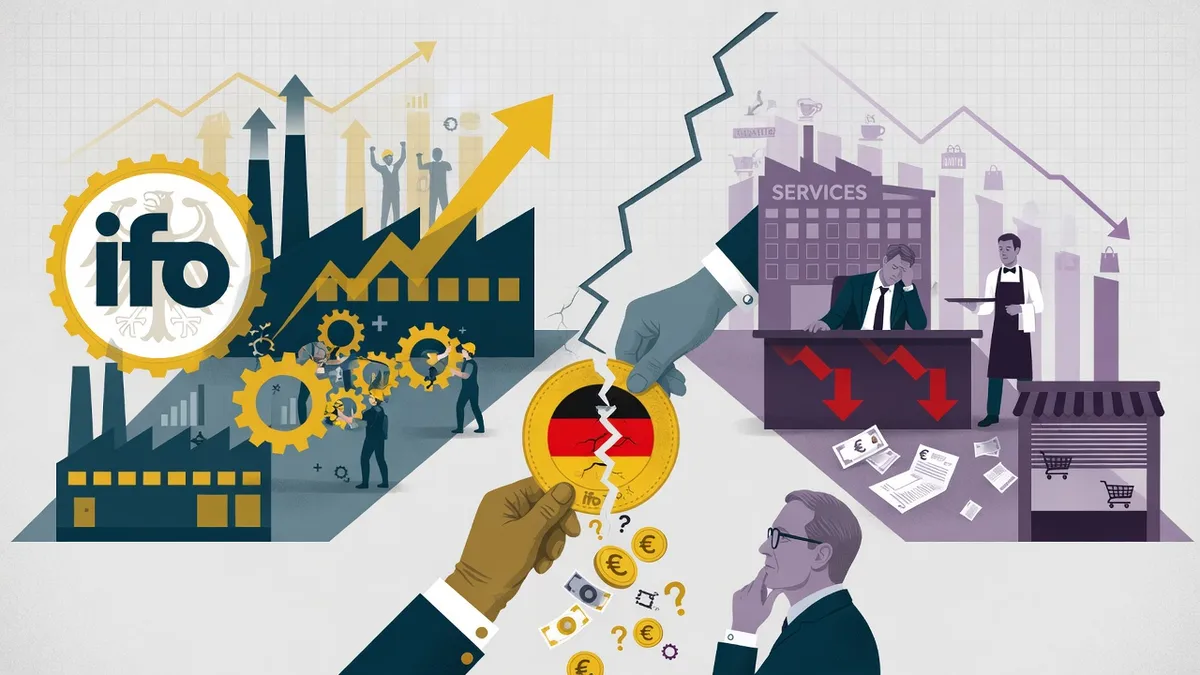
The article analyzes Germany’s October ifo business climate index at 90.2 points, noting rising expectations in industry amid worsening current conditions in services and trade, as well as risks of divergence between optimism and actual corporate profits.
Expectations are rising again in Germany, but not current revenue
On 26 October the ifo institute published Germany’s business climate reading for October: 90.2 points versus 89.9 in September. At first glance the change looks modest, just three-tenths of a point. Yet behind it lies a fundamentally important divergence. The expectations index rose to 91.6 from 90.4, while the assessment of the current situation deteriorated to 88.8 from 89.5. Companies have become more confident about the next six months while simultaneously acknowledging that today’s business environment remains difficult.
This difference defines the investment intrigue. The stock market discounts future profits, while companies pay wages, electricity and working capital from current cash flow. If expectations improve faster than actual orders and margins, equities can receive support even before earnings recover. But such a re-rating becomes vulnerable to disappointment when future results fail to confirm the initial optimism.
The German economy now serves as a laboratory for assessing this gap. Industry reports improved sentiment and growth in new orders; services are losing momentum, trade remains weak, and construction is beginning to revive cautiously. Therefore the blanket thesis of a full German recovery is premature. What we see is not a single economic cycle but several sectoral trajectories with different speeds and sensitivities to energy costs.
What the primary source says, not the market headline
The ifo methodology is based on roughly nine thousand monthly responses from companies in industry, services, trade and construction. Executives assess the current position and expectations for the next six months. The indicators are normalised indices, not actual GDP growth rates or volumes of goods produced. Hence the index moving from 89.9 to 90.2 does not mean the economy is accelerating by 0.3 %.
In October the industrial business-climate balance rose from minus 2.7 to plus 1.2 points. The services sector, by contrast, fell from plus 0.7 to minus 1.2. In trade the balance stayed at minus 17.2, while construction improved from minus 17.0 to minus 15.5. All these figures come from the detailed ifo table published on 26 October. They show the direction of changes within the survey but are not companies’ monetary results.
The institute separately noted that industrialists rated both the current situation and the outlook more favourably and that new orders had increased. In services the assessment of current business worsened, although expectations became more optimistic. In trade the wholesale segment feels better than retail. These details matter more than the headline number, because they determine which segments can receive cyclical support and which still face insufficient demand.
Industry: first positive balance in several years
The most interesting element of the release concerns the manufacturing sector. According to ifo, its current assessments and expectations returned to positive territory for the first time in more than three years. The recovery in orders creates preconditions for an expansion of production. However, the crossing of the zero line in sentiment does not guarantee a positive operating margin. An industrial firm may receive more orders yet face higher energy, component and working-capital financing costs.
For makers of machinery, automation and electrical components the structure of the order book is decisive. Contracts with price indexation on materials and advance payments protect cash flow better than fixed-price, long-lead-time projects. In infrastructure construction margins depend on the ability to pass on rising costs to the client. In automotive manufacturing additional orders may coincide with intense price competition on export markets.
Here it is important to distinguish a cyclical rebound from a sustainable recovery in productivity. If new orders reflect restocking of inventories after destocking, the effect can exhaust itself faster. If demand is tied to long-term investment in electricity grids, defence infrastructure and industrial modernisation, the support horizon will be longer. This should be verified with Destatis data on new orders, industrial output and corporate commentary, not only with the expectations survey.
Services sector: the weak spot of German optimism
While industry lifts the overall index, services show deterioration. The sector balance slipped into negative territory. This is especially important because services are closely linked to employment, consumer spending and domestic business activity. The drop in the current assessment may reflect weak demand, cost pressure or temporary client caution. The index itself does not allow unambiguous identification of each factor’s contribution.
The institute noted relatively favourable dynamics among IT providers. Yet even within digital services the picture is heterogeneous. Companies with long-term contracts in cybersecurity, cloud infrastructure and corporate-system support may enjoy more stable revenue than consultants dependent on discretionary projects. Growth in AI investment can support certain technology niches without automatically accelerating the entire services sector.
For the labour market such a divergence has consequences. An industrial company may plan to expand output yet not hire new staff until orders are confirmed. A services business may cut vacancies faster if client budgets are constrained. Investors therefore need data on employment, hours worked and real wages. Without them it is impossible to understand whether improved business expectations will translate into sustained growth in domestic demand.
Trade: why wholesalers feel better than shoppers
The business-climate balance in trade remained at minus 17.2 points in October. According to ifo, the wholesale segment performed better than retail. This difference shows that the recovery of production chains is not necessarily accompanied by growth in household consumption. Wholesalers can benefit from inventory replenishment and corporate purchases while retail chains continue to compete for a limited consumer budget.
For listed retailers this means pressure on gross margins. When consumers are price-sensitive, companies are forced to use discounts, private-label goods and loyalty programmes more aggressively. Nominal revenue may rise because of inflation, while real sales volumes remain weak. If purchase prices rise faster than retail prices, operating profit deteriorates even if turnover is maintained.
The commercial-real-estate market receives a mixed signal. Logistics space can be supported by production chains, whereas retail premises depend on the resilience of physical footfall and tenants. To assess the sector one should monitor vacancy rates, rent concessions and the financial health of chains. One national ifo uptick is not enough to declare the crisis over for individual retail formats.
Construction: growth from a low base and expensive money
In construction the October balance rose to minus 15.5 from minus 17.0. The improvement is noticeable, yet the negative reading reminds us that sentiment remains below the neutral level. Companies report a more favourable current situation and cautious growth in expectations. However, the construction sector is particularly sensitive to financing costs, project-approval timelines and the client’s ability to secure budgets.
Government infrastructure programmes can support contractors, but cash flows arise not at the moment of a political announcement but as tenders are conducted, permits issued, materials purchased and works performed. For private housing, mortgage rates, real household incomes and land costs matter. Industrial construction depends on the expected payback of new capacity and therefore on energy prices and the availability of skilled labour.
For an investor it is useful to separate suppliers of construction materials, engineering companies, developers and banks. They have different sensitivities to the cycle. A cable producer for electricity grids may receive orders earlier than a residential developer. A bank may face increased demand for financing yet simultaneously require a higher risk premium for projects. Growth in the construction indicator should be evaluated in the context of these differences.
Energy again becomes the main margin constraint
The European economy faces high energy costs linked to tensions in the Middle East and supply disruptions. On 26 October Reuters noted that oil remained at elevated levels after a strong weekly rise. For German industry not only spot Brent but also the cost of natural gas, electricity, diesel and hedging of future consumption matter. The energy shock affects sectors unevenly.
Chemical and metallurgical plants are sensitive to the price of heat and electricity. Carmakers depend more on complex supply chains, logistics costs and demand for finished vehicles. Mechanical engineering faces the risk that clients postpone capital orders if their own energy expenses have risen. Companies with long-term electricity contracts may enjoy temporary protection, but as hedges expire price increases pass through to earnings.
Therefore a positive ifo reading should be compared with the dynamics of TTF, European energy futures and corporate EBITDA forecasts. If orders rise at the same time as costs deteriorate, output volumes may recover without a corresponding rise in profits. This very divergence represents the key risk for any re-rating of industrial equities.
What the ifo improvement means for DAX and STOXX 600
Germany’s equity market is not a pure reflection of domestic GDP. Large DAX companies derive a substantial share of revenue from abroad, and their shares react to global demand, exchange rates, cost of capital and sector trends. Hence an improvement in the national business climate may be positive for certain small and medium-sized companies but does not necessarily determine the performance of the entire index.
Exporters benefit from recovering foreign investment yet may suffer from trade restrictions and weak demand in individual regions. Makers of industrial equipment are sensitive to the investment cycle. Providers of digital infrastructure depend on corporate IT budgets. Banks react to the shape of the yield curve, credit risk and client activity. All these mechanisms can move in different directions even when the overall ifo rises.
For fair-value assessment, P/E multiples are not enough; expected free cash flow, return on invested capital and changes in net debt also matter. A company with accelerating orders but worsening conversion of EBITDA into cash flow may be less attractive than a business with moderate growth and resilient liquidity. Conclusion: the October index provides a reason to revise forecasts, but it does not replace analysis of earnings reports.
Bunds, the euro and the ECB dilemma
Improved German expectations affect the rates market through forecasts of economic activity. If investors begin to anticipate more sustained growth, yields on German government bonds may receive support from real rates. At the same time, however, high energy prices increase inflation uncertainty. The European Central Bank must weigh both the risk of economic slowdown and the possibility of renewed cost increases.
For Bunds the difference between short-term rate expectations and the term premium is crucial. Even with unchanged ECB policy, long-term yields can rise because of increased bond supply or shifts in global demand for safe assets. The euro reacts to relative rate expectations in Europe and the United States, the trade balance, energy import prices and overall risk appetite. Therefore one national survey does not determine the direction of EUR/USD.
What should be watched is the reaction of the OIS curve to ECB decisions, spreads of peripheral bonds versus Bunds, and services inflation data. If industry accelerates while services slow, the regulator may receive conflicting signals. For the currency market this implies heightened sensitivity to new statistical releases and central-bank rhetoric.
Government investment: a large budget does not equal instant GDP
Germany is discussing large-scale investment in defence and infrastructure. Market commentary refers to programmes that could support the economy for several years. Yet the investment multiplier depends on the speed of execution, the domestic value-added share and the availability of production capacity. If the state finances a project that runs into a shortage of engineers, lengthy permitting procedures or imported components, the immediate impact on output may be smaller than expected.
From the standpoint of corporate results, the revenue-recognition schedule matters. An order for railway infrastructure, grid modernisation or defence equipment may be spread over several financial years. For an equipment supplier this creates the appearance of future demand while simultaneously requiring investment in personnel, materials and working capital. Profitability depends on execution quality and contract indexation terms.
Investors should check which companies have confirmed backlog and which merely mention a potential market in presentations. Growth in government spending can support the sector as a whole, but individual shares may become overvalued if market capitalisation already prices in contracts that have not yet been signed.
Three scenarios for Germany through mid-2027
The base case for the next three to six months envisages gradual improvement in industrial output while consumer-facing services remain weak. It is confirmed by sustained growth in new Destatis orders, maintenance of a positive industrial ifo balance and the absence of a sharp deterioration in energy costs. Cancellation criterion: renewed contraction of orders over several months and a reversal of ifo expectations.
The bullish scenario for six to nine months assumes the recovery spreads to trade, construction and employment. Then order growth turns into higher capacity utilisation, profits and investment. Its hallmarks would be rising real retail sales, improved building permits and recovery of industrial operating margins. The hypothesis would be invalidated by worsening real household incomes or renewed sustained growth in energy prices.
The bearish scenario for one to two quarters is linked to the October improvement in expectations proving premature. A prolonged energy shock and expensive capital could delay investment despite managerial optimism. Cyclical equities would then face EPS forecast revisions, while long bonds would react to the combination of weak growth and inflationary risks. Revision criterion: confirmed improvement in output and stabilisation of costs in corporate reports.
How to separate the statistical signal from market noise
A professional investor needs a consistent verification sequence. First the primary ifo source and the difference between the current situation and expectations are assessed. Then new orders, industrial production, exports and consumer data from Destatis are compared. The third layer consists of company reports: organic revenue growth, gross margin, operating leverage, order backlog and conversion of profit into free cash flow.
The fourth layer relates to the capital markets: Bund yields, credit spreads of industrial issuers, EUR/USD and sector valuation multiples. The fifth concerns costs: gas, electricity, logistics and wages. If the survey improvement is accompanied by order growth, resilient margins and narrowing credit spreads, the case for recovery becomes stronger. If confirmation is absent, equity gains may largely reflect a shift in sentiment.
Finally, lags must be taken into account. The executives’ survey captures perceptions of the current month, industrial statistics are published later, and earnings reflect an entire quarter. Attempting to treat all three indicators as synchronous creates false precision. Scenario work requires understanding which stage of the economic cycle each source measures.
Conclusion: the market received hope, not ready-made profit
The October 90.2 points of ifo matter primarily because Germany has ceased to display uniform weakness across all segments. Industry is returning to more constructive expectations, construction is gradually reviving, yet services and trade remind us of weak domestic demand. This makes recovery possible but uneven.
In the coming months the decisive factor will be the transition from managerial optimism to fulfilled orders and cash flow. If this occurs, German cyclical assets will receive fundamental confirmation. If energy costs and expensive capital absorb the additional revenue, the market will face a gap between improving indicators and actual profitability. This gap should be measured before any new industrial cycle is declared to have arrived.
Sources
Article prepared by the analytical department of TradePass